How Professional Corporate Event Transportation Management Contributes to a Successful Event
Introduction: The Part of the Event Plan That Is Easy to Underestimate
Picture a two-day corporate conference in Hyderabad. The venue is booked, catering is confirmed, the stage branding is ready, speakers are finalised, and hotel rooms are blocked. On paper, everything looks in control. Then reality begins on the morning of day one.
A senior leader’s flight lands 40 minutes early. Two delegates are staying at a different hotel than the rest of the group. A group of employees needs to reach the venue together by 8:30 AM. A speaker’s session is moved forward, which means the pickup has to happen sooner. Someone cannot find their assigned vehicle in the arrivals crowd. And by evening, there are late-night return drops to coordinate after the networking dinner runs long.
None of these are catering problems, venue problems, or content problems. They are transportation problems — and they can quietly affect the guest experience and the event timeline more than almost anything else.
Corporate event organizers often plan venues, catering, branding, speakers, accommodation, and schedules with great care, yet transportation is sometimes treated as a last-minute vehicle booking. In practice, event movement involves flights arriving at different times, guests staying across multiple hotels, VIPs requiring dedicated vehicles, employees needing group transport, multiple pickup and drop points, sudden schedule changes, late-night returns, and constant driver-and-guest communication.
This article makes a simple argument: event transportation should be treated as an operating function, not a booking task. It explains how structured planning, on-ground coordination, live tracking, and privacy-conscious information handling come together to support a well-run event — and how Multi Cabz works as a corporate event transportation operations partner in Hyderabad, not simply a cab supplier
Why Transportation Matters to Corporate Event Success
Transportation touches almost every visible outcome of an event, even though it happens between the milestones rather than on stage.
- Guest punctuality — If pickups slip, sessions start late and the schedule compresses for everyone.
- Speaker arrival — A delayed speaker can force agenda reshuffles in front of a live audience.
- Leadership movement — Senior executives expect calm, dependable, dedicated movement between airport, hotel, and venue.
- Employee attendance — Group shuttles determine whether teams arrive together and on time.
- Event schedules — Movement plans and the run-of-show are directly linked; one affects the other.
- Brand perception — The first and last impression of an event is often the vehicle, the driver, and the pickup experience.
- Guest satisfaction — Smooth arrivals and departures reduce stress and set the tone for the whole visit.
- Organizer workload — Poor transport coordination pulls organizers into constant phone calls instead of running the event.
- Safety and coordination — Clear allocation, briefed drivers, and monitored movement support a safer guest experience.
- Overall event experience — Guests may forget a lot, but they remember being stranded, confused, or rushed.
Corporate Event Transportation Is More Than Hiring Cabs
There is a meaningful difference between a basic cab supplier and a professional event transportation management partner, and understanding it helps organizers set the right expectations.
A basic cab supplier provides vehicles. You call, you get cars, and coordination is largely your responsibility. That model can work for a single ride, but it strains quickly under the volume, timing, and complexity of a corporate event.
A professional transportation operations partner takes on the operation behind the vehicles:
- Planning the movement across airports, hotels, venues, and pickup points
- Allocation of the right vehicle categories to the right guests and timings
- Communication with drivers, guests, and the organizer through a single channel
- Monitoring arrivals, departures, and trip status in real time
- Coordination between multiple locations happening at once
- Changes — absorbing last-minute additions, delays, and re-routing
- Contingencies — keeping backup vehicles and a fallback plan ready
In short, a cab supplier answers the question “Can I get vehicles?” An operations partner answers the harder question: “Will every guest move correctly, on time, across the whole event?”
Common Transportation Challenges in Corporate Events
Experienced organizers recognise these situations because most events contain several of them at once:
- Guests on different flight arrival times, sometimes spread across an entire day
- Delayed flights that push back a carefully sequenced pickup plan
- Incorrect or incomplete pickup details shared at the last minute
- Guests spread across multiple hotels with different call times
- High-volume guest movement in tight windows before a session
- Duplicate or missed vehicle allocation when lists change repeatedly
- Driver confusion about which guest, which hotel, and which route
- Guests unable to locate their vehicle in busy arrival or hotel areas
- VIP handling requirements needing dedicated, discreet arrangements
- Last-minute guest additions that were never on the original list
- Venue timing changes that ripple across every downstream trip
- Late-night departures after dinners, networking, or extended sessions
- Inadequate backup support when a vehicle or driver becomes unavailable
- Poor communication between drivers and organizers during live movement
Each of these is manageable on its own. The challenge is that they tend to happen together, in real time, while the organizer is also running the event itself. This is precisely where a structured operation earns its value.
How Multi Cabz Plans Corporate Event Transportation
Multi Cabz approaches each event as a movement operation with a clear, repeatable structure. The scale changes from event to event, but the discipline stays consistent.
- Understanding event requirements — event type, dates, guest profile, venues, and expected movement patterns.
- Collecting guest and travel schedules — flight or arrival details, hotels, session timings, and special requirements.
- Mapping airports, hotels, venues, and pickup points — building a clear picture of the geography involved.
- Estimating vehicle categories and quantities — matching sedans, SUVs, and larger vehicles to guest types and group sizes.
- Preparing a movement plan — sequencing pickups, transfers, and returns against the event schedule.
- Allocating vehicles and drivers — assigning the right vehicle and driver to each trip.
- Briefing drivers and crew — sharing routes, timings, guest expectations, and points of contact.
- Deploying coordinators at key locations — placing on-ground crew where movement is heaviest.
- Monitoring operations through live sheets and WhatsApp — tracking status and communicating in real time.
- Managing changes and backup requirements — absorbing delays, additions, and re-routing as they happen.
- Completing trip reconciliation and billing — closing out the event with clear trip records and GST invoicing.
The value of this structure is that nothing depends on memory or chance. Every trip has an owner, a timing, a vehicle, and a status — which makes the event far easier to run under pressure.
On-Ground Operations Crew
Technology and planning matter, but corporate events are ultimately managed by people who are physically present where guests are moving. Multi Cabz deploys an on-ground operations crew sized to the scale and complexity of each event.
Depending on the event, coordinators may be positioned at:
- Airport terminals — receiving arriving guests and connecting them to vehicles
- Hotels — managing morning departures and evening returns
- Venues — handling drop-offs, holding areas, and pickups around sessions
- Pickup hubs and assembly points — organising group and shuttle movement
- VIP movement locations — supporting dedicated, discreet leadership movement
Their practical responsibilities during the event include:
- Monitoring arrivals and matching guests to the right vehicles
- Coordinating drivers and keeping them positioned correctly
- Helping guests identify and reach their vehicles
- Confirming vehicle departures against the plan
- Updating live movement status so the whole team stays aligned
- Handling last-minute changes on the spot
- Communicating directly with the event organizer
- Escalating operational problems quickly
- Supporting return and departure movements at the end of the day
This on-ground presence is often the difference between a delay that is quietly absorbed and one that becomes a visible problem for guests.
Use of Live Excel Tracking and WhatsApp Coordination
Multi Cabz follows a hybrid operating model that combines experienced human coordination with practical, dependable technology. It is worth being honest and specific about what that means, because event organizers value clarity over buzzwords.
Multi Cabz does not rely on a fully automated software platform. Instead, human decision-making is supported by tools that teams can update and read instantly:
- A live Excel or shared tracking sheet that holds guest schedules, flight or arrival details, hotel information, pickup timings, vehicle allocation, driver details, trip status, and operational changes
- WhatsApp for operational reminders, driver coordination, guest communication, schedule updates, and event-day instructions
- Driver instructions and route details shared clearly before and during movement
- Vehicle status tracking kept current as trips begin, complete, or change
- Team coordination across coordinators at different locations
Why does this hybrid model work well during live events? Because event schedules change quickly, and the fastest way to reflect a change is often a shared sheet everyone can see and a message everyone receives at once. A person makes the judgement call; the tools make sure the whole team acts on it immediately. The result is speed and adaptability during exactly the moments when rigid systems tend to struggle.
Privacy-Conscious Handling of Event Information
Corporate events involve guest names, travel details, and executive movement — information that deserves careful handling. Multi Cabz follows a privacy-conscious process built around controlled information sharing rather than broad claims.
- Event information is used for operational coordination — to move guests correctly, not for any unrelated purpose.
- Access is limited to the assigned operations team on an event-specific basis.
- Crew members use company-managed communication devices for event-related communication rather than personal phones.
- Personal devices are avoided for assigned event operations wherever practical.
- Guest and travel data is removed after the event is completed, subject to billing, accounting, contractual, statutory, or other legally required record-retention obligations.
- Sensitive information is not shared beyond operational necessity.
Multi Cabz intentionally avoids absolute claims such as “100% secure,” “completely risk-free,” or “fully compliant.” What it offers instead is a sensible, professional approach: event-specific access, company-managed communication devices, and data handling that is subject to operational and legal record-retention requirements. For many corporate teams, that credible clarity is more reassuring than an overstated promise.
Experience Across 30+ Corporate Events
Experience is one of the most reliable indicators of whether a transport partner can handle event conditions. Over the past four years, Multi Cabz has supported 30+ corporate events in and around Hyderabad.
These engagements have varied widely in scale. Requirements have ranged from smaller assignments involving 10+ vehicles to large-scale operations involving up to 300+ vehicles, subject to the confirmed scope of each event. That range matters, because it means the same operating discipline has been tested at very different sizes.
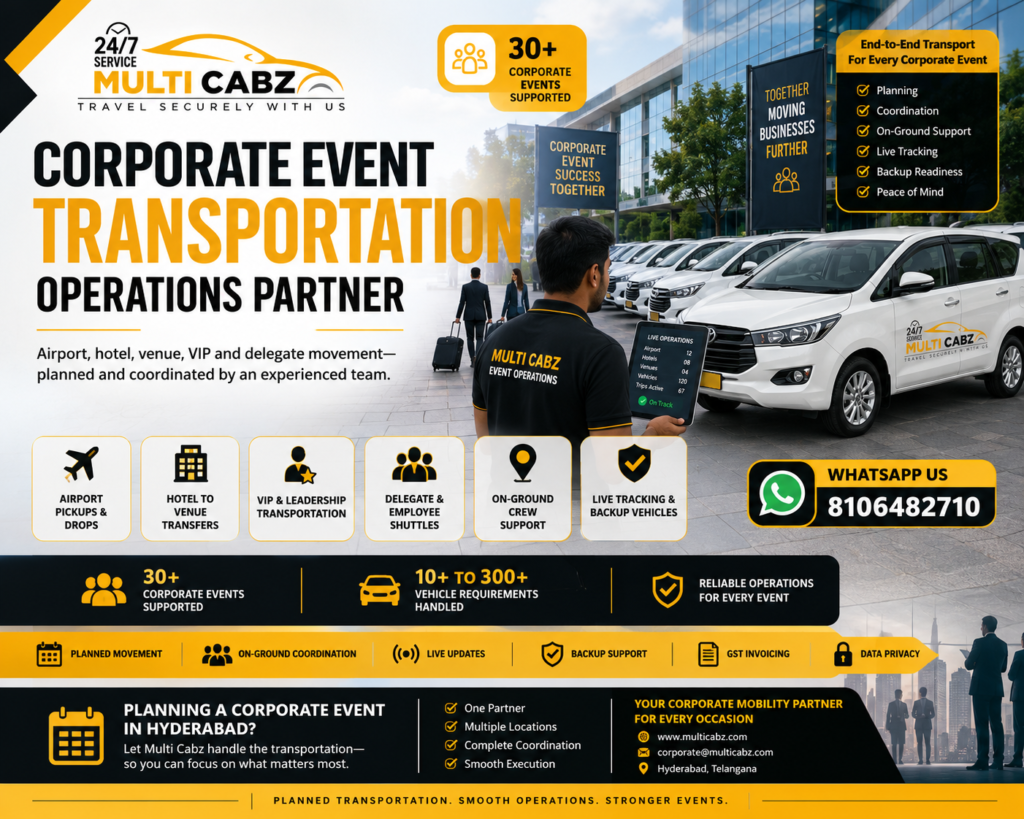
Across these events, Multi Cabz has handled airport pickups and drops, hotel-to-venue transfers, venue-to-hotel returns, VIP and senior leadership transportation, speaker and delegate movement, employee and guest shuttles, multi-location pickups, return drops, late-night transportation, last-minute schedule changes, and backup vehicle arrangements.
This experience is presented as a trust signal, not a set of guarantees. Multi Cabz does not attach client names, event names, passenger figures, or performance claims to this record — the point is simply that the team has repeatedly operated across the full spectrum of corporate event movement.
An Illustrative Corporate Event Movement Scenario
The following is an illustrative scenario created to show how the operation works. It is not a named case study or a description of a specific client.
Imagine a two-day corporate conference in Hyderabad with delegates flying in from several cities. On day one, guests arrive at Hyderabad airport across a wide window, and they are staying at three different hotels. Senior leadership requires dedicated premium vehicles. A group of employees needs scheduled shuttles to the venue. Two keynote speakers require separate, carefully timed movement. In the evening, there are return drops after a networking dinner.
Midway through the morning, a leader’s flight is delayed by over an hour — which affects a planned VIP pickup and a downstream venue arrival.
Here is how the operation absorbs it. The live movement sheet already shows every guest’s flight, hotel, vehicle, and driver, so the coordinator at the airport immediately sees the delay’s impact. Over WhatsApp, the driver assigned to that VIP is repositioned and a backup vehicle is placed on standby in case timings tighten further. The venue coordinator is informed so the arrival is managed calmly. The employee shuttle, which is unaffected, continues on schedule. By evening, the return drops are sequenced from the sheet so guests are grouped sensibly by hotel.
No single element solved the problem alone. It was the combination — on-ground crew, a live sheet, clear driver allocation, WhatsApp coordination, and backup readiness — that kept a normal disruption from becoming a guest-facing failure.
Why Corporate Organizers Should Appoint One Transport Coordination Partner
Spreading transportation across several vendors often multiplies the coordination burden. Appointing a single event transport coordination team offers practical advantages:
- One communication point instead of many scattered contacts
- Centralized vehicle allocation across all guests and movements
- Consistent driver instructions and shared standards
- Better reporting on trips and status
- Easier changes when plans shift, because one team holds the full picture
- Reduced organizer calls, freeing the organizer to run the event
- Coordinated billing and cleaner reconciliation
- Clearer accountability when questions arise
- Faster escalation through a known point of contact
- Better guest support because the team understands the whole event, not one slice of it
A single coordination partner does not guarantee a flawless event — nothing can. What it does is remove the friction of managing multiple vendors during a live, fast-moving operation.
Checklist for Choosing a Corporate Event Transport Vendor
Use this checklist when evaluating a transport partner for a corporate event:
- Demonstrated corporate event experience
- Capacity to handle varying fleet sizes, from small to large deployments
- Driver verification and briefing practices
- A suitable range of vehicle categories
- On-ground crew support at key locations
- Airport coordination capability
- Live operational tracking of guests and vehicles
- Clear backup planning for vehicles and drivers
- Sensible data-handling practices
- Proper GST invoicing
- Trip reconciliation and records
- Single-point coordination
- Reliable escalation support
- Ability to handle last-minute changes
Conclusion
Transportation is not a side task that sits outside the event — it is part of the event experience itself. It shapes first impressions, keeps the schedule intact, supports leadership and speakers, and determines whether guests feel looked after from the moment they land to the moment they leave.
For that reason, it deserves the same seriousness as the venue, hospitality, accommodation, and event schedule. Planned as an operation — with structured movement plans, experienced on-ground crew, live tracking, clear communication, contingency planning, and responsible handling of guest information — transportation becomes a quiet strength rather than a recurring risk.
Multi Cabz works as a Hyderabad-based corporate event transportation operations partner, capable of supporting both smaller corporate movements and large-scale fleet requirements, and focused on reducing the operational pressure on event organizers.
Frequently Asked Questions
Q.What is corporate event transportation management?
It is the structured planning and coordination of all guest, executive, employee, and speaker movement across an event — including airport, hotel, and venue transfers — managed as an operation rather than as individual vehicle bookings. It covers planning, allocation, on-ground coordination, live tracking, changes, and contingencies.
Q.How early should corporate event transportation be planned?
As early as guest counts, travel schedules, and venues begin to take shape. Earlier planning allows better vehicle estimation, clearer movement plans, and more room to arrange backup support. That said, Multi Cabz is also experienced in managing last-minute changes and additions.
Q.Can Multi Cabz manage airport, hotel, and venue transfers?
Yes. Multi Cabz has handled airport pickups and drops, hotel-to-venue transfers, venue-to-hotel returns, multi-location pickups, and return drops as part of corporate event movement.
Q.Can vehicles be arranged for VIPs and senior executives?
Yes. Multi Cabz supports VIP and senior leadership transportation with dedicated vehicles and coordinated movement, arranged according to the event’s requirements.
Q.Does Multi Cabz provide on-ground coordinators?
Yes. Depending on the size and complexity of the event, Multi Cabz deploys an operations crew that may be positioned at the airport, hotels, venues, pickup hubs, and VIP movement points to coordinate drivers and support guests.
Q.Can Multi Cabz handle large fleet requirements?
Yes. Requirements have ranged from smaller assignments involving 10+ vehicles to large-scale operations involving up to 300+ vehicles, subject to the confirmed scope of each event.
Q.How are last-minute changes managed?
Changes are handled through a combination of on-ground crew, a live shared tracking sheet, and WhatsApp coordination, supported by backup vehicle arrangements where needed. This hybrid model allows the team to reflect and act on changes quickly during live events.
Q.How is guest travel information handled?
Event information is used for operational coordination and shared only with the assigned operations team. Crew members use company-managed communication devices, and guest and travel data is removed after the event is completed, subject to billing, accounting, contractual, statutory, or legally required record-retention obligations.
Q.Can Multi Cabz provide GST invoices and trip records?
Yes. Trip reconciliation and GST invoicing are part of the process, so organizers receive clear records at the close of the event.